Joist spans, bearer sizes and AS 1684
AS 1684 is the document that sizes a timber deck frame. How bearers and joists share the load, what stress grades mean, why 450 millimetre centres exist, and when a span table is no longer enough.
By Custom Decking editorialUpdated 2 October 2025
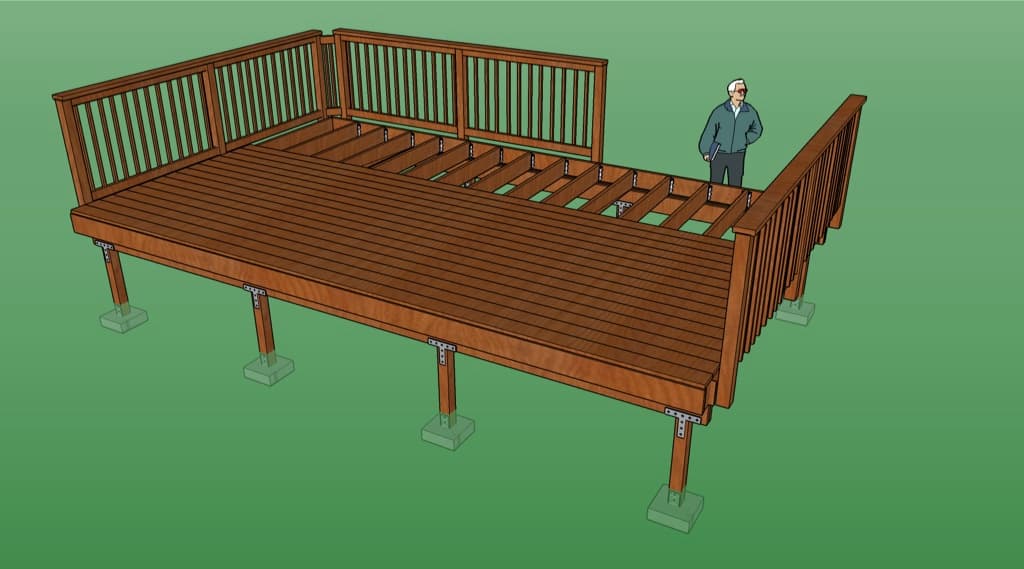
The frame is a floor before it is a deck. Boards hide it; they do not forgive it. When a platform bounces, when a wide board cups between supports, when a bearer sags toward a post that was set a bit further out than the drawing, the argument is almost always a span argument. AS 1684 — Residential timber-framed construction — is the document Australian carpenters are meant to open before they open the nail gun.
This essay sits in structure and building next to footings, stumps and posts. The holes hold the posts; the posts hold the bearers; the bearers hold the joists; the joists hold whatever you chose in decking boards and fasteners. Species still matters — Australian hardwoods on top, treated pine in most frames — but species is not a span table.
What AS 1684 is, and what it is not
AS 1684 is a set of methods and span tables for conventional timber houses and the structures that belong with them. Part 2 covers non-cyclonic wind regions. Part 3 covers cyclonic regions. The wind classification of the site — often from AS 4055 on a house job — decides which book you are in. A tropical Queensland deck in a C-class wind region is not framed from a Melbourne habit.
The standard assumes regular spacing, familiar grades, and members that are used the way the tables were calculated. It is not a licence to invent a cantilever, a knife-edge support, or a bearer that also wants to be a retaining wall. It is not AS 1170, which is the actions standard: dead load, live load, wind, and the other forces the frame must be shown to resist. AS 1684 is how a lot of those actions get turned into a dressed size you can order.
If the deck is a simple rectangle, a sensible height, timber throughout, and the wearing surface is a known board, the tables will usually get you there. If the deck is a polygon around a pool, a frame that becomes a waterproofed terrace over a room, a mixed steel-and-timber grid, or a platform that will carry a kitchen island and a crowd, you are in design territory. Pay for a drawing. Do not photocopy a table and hope.
Bearers and joists do different jobs
A bearer is the member that takes the joists to the posts. It is a beam. Its span is the distance between posts or other supports, and its job is to stay stiff enough that the joist field does not become a valley. A joist is the member the boards are fixed to. Its span is the distance between bearers (or between a bearer and a ledger), and its job is to hold the wearing surface flat under a heel, a table and a wet night.
Confusing the two is how a quote lists “150 by 50 throughout” and then wonders why the long direction is lively. Depth does more for stiffness than width. A deeper joist on a sensible centre will feel like a floor. A shallow joist on a stretched centre will feel like a pontoon. Doubling a shallow member is not the same as using a deeper one; two thin joists side by side still have the depth of one thin joist unless they are designed as a couple.
Continuous members — a bearer or joist that runs over more than one support — behave better than a collection of short sticks butted over each post. The tables know this. So does every carpenter who has watched a butt joint open as the timber dries. Stagger the joints. Support them. Do not hide a join in the middle of a span because the pack was short.
Cantilevers are a designed length, not a leftover. A joist that runs past the last bearer to pick up a stair string or a bay window of decking has a limit. Beyond that limit the end droops, the fastener at the last bearer works harder, and the stair you hung from it starts to argue with the landing. If the table does not give you the cantilever, an engineer does.
Grade, seasoning and the stamp on the end
Span is not a species romance. It is a stress grade and a section. Seasoned pine on the Australian rack is commonly MGP10 or MGP12 — machine-graded pine with a number that is a design value, not a marketing score. Unseasoned hardwood might arrive as F5, F7 or better, depending on the mill and the species. Seasoned hardwood structural grades exist and are a different product from a decking board with a pretty face.
The stamp is the specification. A dressed, treated pine joist without a grade mark is a piece of timber, not a structural member you can table. “It looks like the last lot” is not a grade. If the merchant substituted a lower grade after the quote, the spans may have to close up. That is a variation, not a favour.
Seasoning matters because a wet member shrinks, and a member that shrinks after it is packed out will leave the packers and the fixings in a different geometry from the one you built. Unseasoned bearers are still used; they are used by people who expect movement and who do not tile a kitchen onto the result. Over a living space, or under a finish that cannot tolerate a change in level, prefer seasoned or engineered members and a detail that can still drain.
Engineered joists — I-joists, laminated veneer, a proprietary cassette — have their own manuals. They can be excellent. They are not interchangeable with a solid pine table. Hole positions, bearer seating, and the way you fix decking (especially with hidden clips that want a wide landing) are all product rules. Read them.
Steel joists and channels belong in the same honesty. They span further, they do not interest termites, and they still have to be sized, coated, and connected. A coastal steel joist is a corrosion specification. An inland steel joist under treated pine is a dissimilar-metal specification. Neither is “the same as 190 pine.”
Centres: 450, 600 and the board you actually bought
Joist centres are the spacing that the decking manufacturer, and then AS 1684, have to agree on. For nineteen millimetre hardwood, 450 millimetres is the ordinary Australian residential rhythm. It is also the rhythm that makes a 140 millimetre board less likely to cup into a spring. Six-hundred millimetre centres save timber. They are common under thicker boards, under some commercial floors, and under wearing surfaces that were designed for them.
Composite decking and bamboo and other alternative systems often want closer centres than a timber carpenter assumes, and they want them even in the last bay. If the wearing surface changed during a value-manage, the joist field may have to change with it. That is how a cheaper board becomes a dearer frame.
Board direction is a design choice with a structural consequence. Decking usually runs across the joists. If the architecture wants boards parallel to the house on a frame that was set out the other way, you need another layer — a counter-joist, a change of spanning direction — not a hope. Melbourne weather will find the board that was asked to span the wrong way; so will a dry inland summer.
Blocking, nogging and herringbone strutting stop joists rolling and share load at points of trouble — under a spa, at a stair opening, at a cantilever root. A tall joist with no restraint is a member that can twist. The tables and the manuals say when restraint is required. Skipping it because it does not show in the photograph is how a floor becomes a set of individual sticks.
Openings, ledgers and the places tables go quiet
Stairs need an opening. The trimmed joist and the trimmer are beams. They are sized, hung, and supported; they are not the leftover of a cut. Landings are floors. If you cut three joists and hang a stair on the last remaining one, you have invented a span the table never wrote.
A ledger on the house is a bearer that happens to be a wall. It needs a designed connection, a flashing path, and a joist hanger or seating that puts the load into the ledger the way the hanger manufacturer drew. Do not nail a joist beside a weatherboard and call it a hanger. Do not use a hanger in a corrosion zone that the hanger was not made for.
Double joists under butts, under a kitchen leg, under a line of outdoor kitchen mass, are ordinary. So is a bearer that steps up to take a change of level. What is not ordinary is a single undersized member asked to do all of those jobs because the set-out was pretty.
Load you can name, and load you pretend is not there
AS 1170 gives the imposed load for a domestic deck as a uniformly distributed load and as a concentrated load. We are not going to reprint the numbers as if they were a pamphlet; the current standard is the document, and it is updated. What matters on site is that a deck is not a shelf. People gather. A barbecue is rolled. A planter is filled with wet soil and never moved. A spa is a water tank.
If the use is heavier than a household platform — a commercial terrace, a roof deck that is really public, a gym of outdoor furniture — the residential table may be the wrong book. Say the use on the drawing. A certifier who is told “residential deck” and then finds a plunge pool has been given the wrong job.
Snow is not an Australian deck conversation except in a few alpine sites, where it suddenly is. Wind is an Australian conversation everywhere. The joist field is a diaphragm if you detail it that way, and a pile of sticks if you do not. Permanent bracing, not only temporary props, keeps the rectangle a rectangle.
Moisture, ventilation and the frame you cannot see
A correctly sized joist that cannot dry is still a short-lived joist. Close the subfloor against a garden bed, wrap the perimeter in an unventilated screen, and sit the frame over damp ground, and H3 pine will still decay. Treatment is time, not a repeal of physics. Leave an air path. Keep soil off the timber. Detail the termite inspection so the frame can be seen.
Over a room, the joist is sitting in a roof. Falls, membranes and outlets come first; the timber sizes come second. Do not run a level joist field over a membrane that needed a fall and then wonder about the stain on the ceiling. The waterproofing essay is the pair to this paragraph.
In bushfire country the joist can be part of the BAL system or part of the reason the system fails. A listed board on an unprotected pine joist is a conversation with the certifier. Balustrades and the NCC and stairs have their own clauses; the frame has to belong to the same story.
Specifying a frame that can be built
Write the standard, the wind class, the member sizes, the grades, the centres, the bearer spans and the joist spans on the quote. Write whether the members are seasoned. Write the hanger and the stirrup. Write the wearing surface and its required centres, so a late change of board cannot sneak past the frame. Then walk the set-out before the first hanger goes on.
AS 1684 is a tool. It is a good tool. It is not a substitute for looking at the site, naming the load, and knowing when the table has ended. The materials choice sits on top of this. The design choice decided whether the frame is a simple grid or a puzzle. Structure is the part that makes both of those choices stay put.
If a grade, a part number of AS 1684 or a centres claim in this piece is out of date, send the current table to contact. We correct against the standard, not against a merchant’s memory. How we handle that is on editorial standards. The cutaway on this page is credited on image credits.
Questions readers ask
- Can I run joists at 600 millimetre centres under 19 millimetre decking?
- Sometimes, if the board, the species and the manufacturer’s table allow it. Often you cannot. Nineteen millimetre hardwood on 450 millimetre centres is ordinary residential practice. Stretching to 600 to save a joist is how a wide board springs under a heel. Change the wearing surface and you may have to change the centres with it.
- Is AS 1684 enough, or do I need an engineer?
- AS 1684 will size a conventional, regularly supported timber frame inside its scope — the right grade, the right span tables, the right wind classification. An engineer is the next document when the deck is irregular, heavily loaded, steel-and-timber mixed, attached in a way the tables do not draw, or sitting over a room that is really a roof.
- Does treated pine span the same as hardwood?
- No. Span is a function of grade, size, seasoning and how the member is supported, not of the word “timber”. An MGP10 pine joist and an F17 hardwood joist of the same depth are different products. Read the table for the stamp on the end, not for the last job the carpenter liked.
Keep reading
Related essays

Lighting a deck so it works after dark
Night is when a deck earns its keep or becomes a hazard. Low-glare light, stairs you can still see, AS/NZS 3000 in general terms, and the honest difference between solar stakes and a hardwired circuit.
Waterproofing a deck over a living space
A deck over a room is a roof. Falls, membranes, outlets, thresholds and the wearing surface that must not destroy the work underneath — AS 4654, the NCC, and the Australian climate that will test all three.
Balustrades, glass and the National Construction Code
When a deck needs a barrier, what height and openings the NCC requires, how glass and wire actually get specified, and why a pool fence is a different standard from a balustrade.